When a Table of Contents spans multiple pages in a document, you’ll handle that much like you would a table or list spanning multiple pages, using “Connections.”
Oftentimes, CommonLook will automatically join TOC containers for Tables of Contents spanning across page breaks. It may, however, need your input.
If you need to manually connect a TOC, you’ll do this in the “Full Document Review” step.
When in “Full Document Review,” do the following:
- Make sure all “pieces” of the TOC are in TOC containers and their TOC Items, TOCI item levels, and marked page numbers are correct. For more information, check out the article “Tables of Contents (Simplified Editor).”
- Select the “Connections” button at the upper right side of the interface, below the “Page Elements” and “Reading Order” buttons.

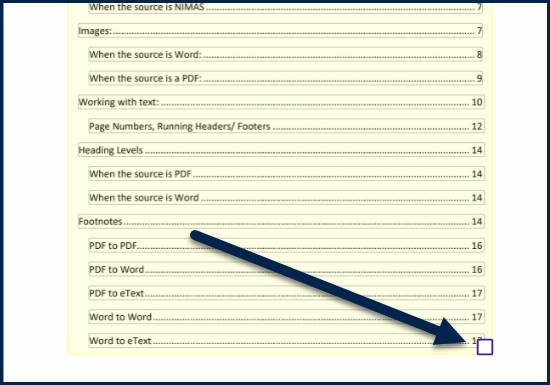
- Check the checkbox at the bottom right corner of your first TOC to connect.
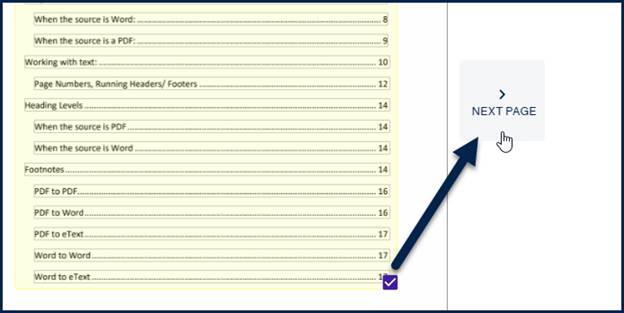
- Use the “Next Page” button to navigate to the next page, where the TOC continues.
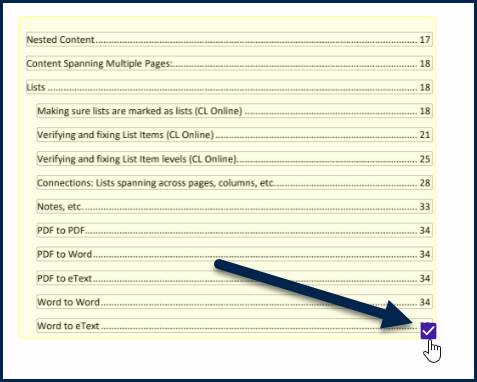
- Check the checkbox at the lower right corner of the second TOC you’re connecting to.
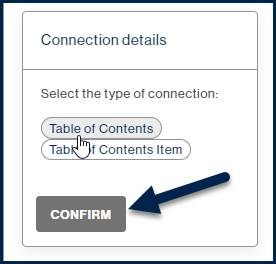
- In the “Connection details” options, choose “Table of Contents.”
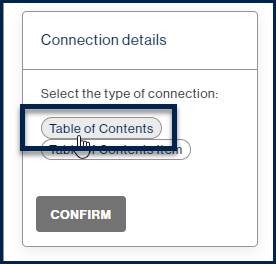
- Use the “Confirm” button to connect the Tables of Contents.
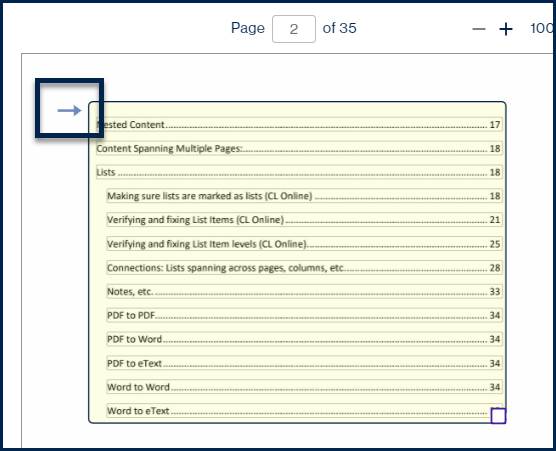
- When your TOCs are connected, you’ll see a blue arrow on the page view, indicating that the TOC is connected to the next one (or the previous one, depending on which page you’re on).
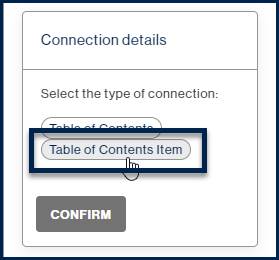
Choosing “Table of Contents Items” in “Connection details”
When making connections, if the content of one TOC Item flows to the next page, choose “Table of Contents item” in “Connection details.”
Was this article helpful?
That’s Great!
Thank you for your feedback
Sorry! We couldn't be helpful
Thank you for your feedback
Feedback sent
We appreciate your effort and will try to fix the article