Understanding Source File Types in CommonLook Edu
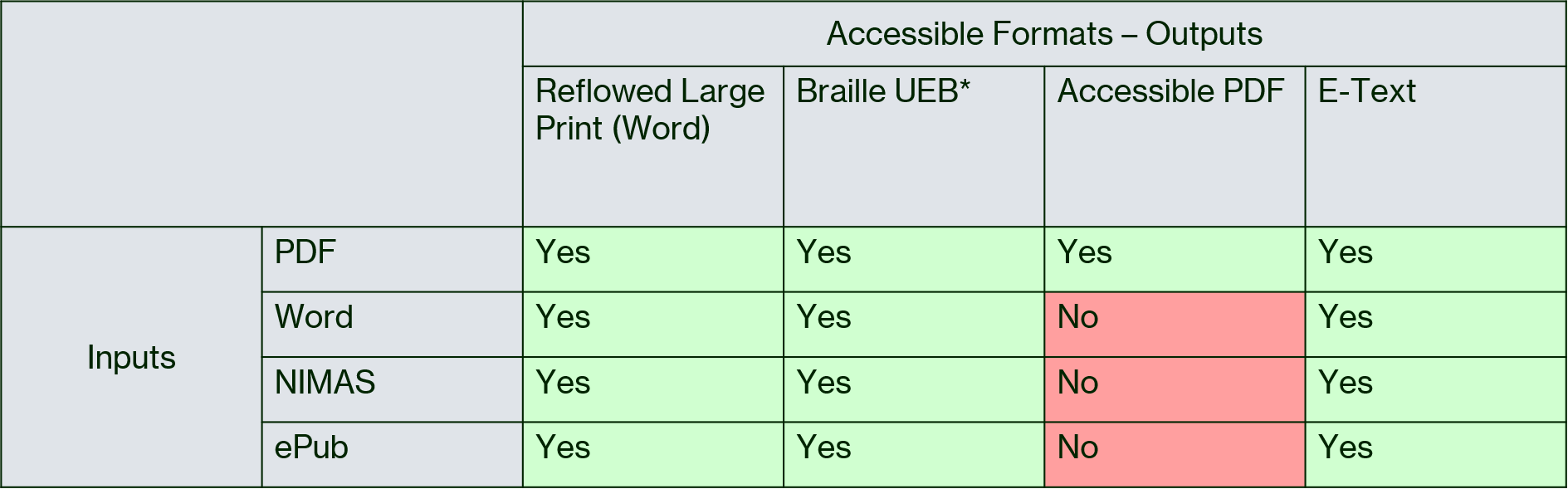
CommonLook Edu accepts four source file types for conversion to accessible formats: PDF, Word, NIMAS, and ePub. Each format has a different origin and structure, which is why each one behaves differently when converted, and why some conversions are available from certain inputs but not others. Here is a table showing possible input and output combinations that CommonLook Edu can and cannot provide.
PDF (Portable Document Format) is the most common document type in educational and organizational settings. PDFs are typically the final, published form of a document: a textbook chapter, a course handout, or a scanned form. Because PDF is a fixed-layout format originally designed for print fidelity rather than accessibility, the quality of a conversion depends heavily on the source PDF. In many situations, even with a well-crafted source file, the PDF is inaccessible.
CommonLook Edu can convert PDF to all four accessible outputs: Reflowed Large Print (Word), Braille UEB, Accessible PDF, and E-Text.
It's worth noting that the only way to achieve an Accessible PDF output from CommonLook Edu is using a PDF input.
Word (.docx)
Microsoft Word documents are a common working format in schools and organizations. When authors use proper heading styles, list formatting, and alt text, Word files may carry a strong semantic structure that translates well into accessible outputs.
CommonLook Edu can convert Word to Reflowed Large Print, Braille UEB, and E-Text. Accessible PDF is not an output from Word source files, as PDF remediation workflows require a PDF as the starting point.
NIMAS
NIMAS (National Instructional Materials Accessibility Standard) is an XML-based file format. Publishers of K-12 instructional materials are required to provide NIMAS files, which are deposited into the NIMAC (National Instructional Materials Access Center), a federally funded repository accessible to authorized organizations serving students with print disabilities.
NIMAS files are purpose-built for alternate format production. They contain the raw text, structural markup, and image references of a printed textbook or instructional material, making them an especially reliable source for producing high-quality accessible outputs. Because NIMAS files represent the source content of a book rather than a final rendered document, Accessible PDF is not an available output.
CommonLook Edu can convert NIMAS to Reflowed Large Print, Braille UEB, and E-Text.
ePub
ePub is a common ebook format. ePub includes robust accessibility support, with semantic markup, logical reading order, and optional media overlays for synchronized audio and text. ePub files are commonly found in digital library collections, publisher catalogs, and learning management systems.
Like NIMAS, ePub is a source content format rather than a rendered document, so Accessible PDF is not an available output.
CommonLook Edu can convert ePub to Reflowed Large Print, Braille UEB, and E-Text.
Why Accessible PDF is only available from a PDF input
The Accessible PDF output is a remediated version of an existing PDF. The process involves reading, tagging, and repairing the structure of a PDF document. Word, NIMAS, and ePub are not PDF files and do not have a PDF to remediate, so that conversion path does not apply to those source types. If an Accessible PDF is needed from a Word, NIMAS, or ePub source, the typical workflow is to first export or print to PDF, then process that PDF through CommonLook.
Access to the Simplified and Advanced Editors
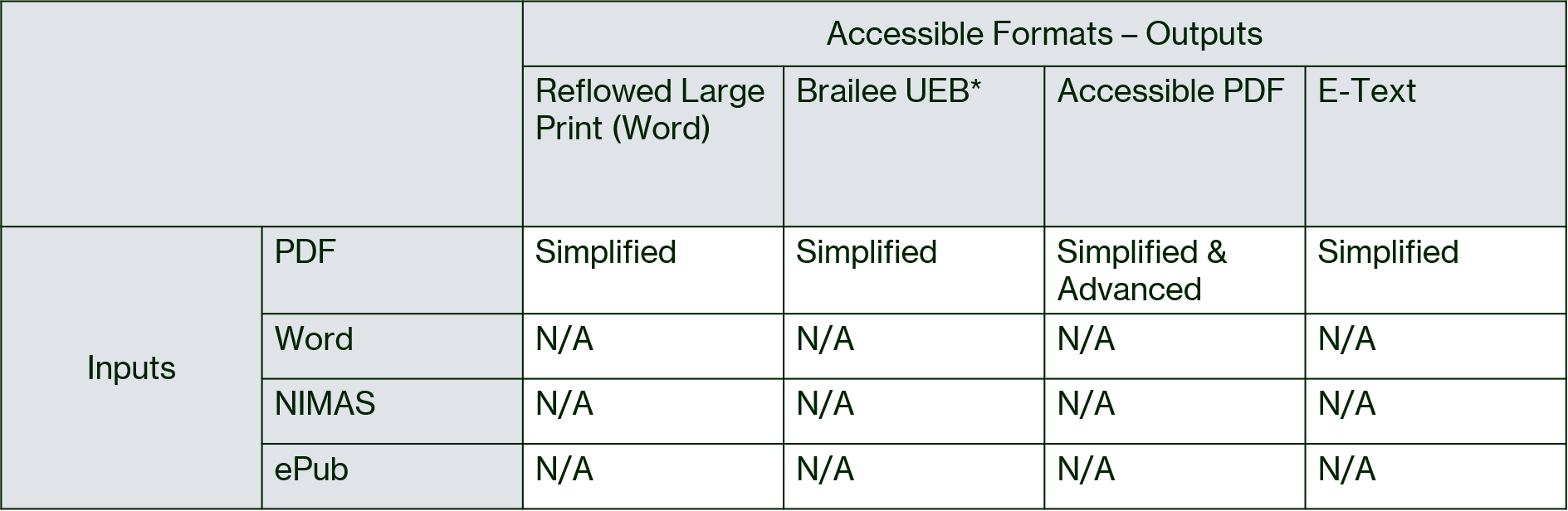
CommonLook Edu has a Simplified and Advanced Editor that can be used in different circumstances. When these Editors are not available for a given input type, the conversion is done automatically.
Was this article helpful?
That’s Great!
Thank you for your feedback
Sorry! We couldn't be helpful
Thank you for your feedback
Feedback sent
We appreciate your effort and will try to fix the article